VDA5050
Repo: vda5050_fiware_repo · Image: vda5050_fiware:latest · Container: vda5050_fiware
What is VDA5050?
VDA5050 is an open, vendor-neutral standard (by the German VDA) defining a common interface between a central master control and Automated Guided Vehicles (AGVs / AMRs). It runs over MQTT and uses JSON messages — chiefly order (the route/actions a robot should do), state (what the robot reports back), connection, and instantActions — so robots from different vendors can be coordinated through one protocol. This project targets v2.0.0 of the spec.
The bridge between VDA5050 AGV communication (orders & state over MQTT) and the rest of the system. It plays the VDA5050 master: it issues/stitches orders to AGVs and tracks their state.
🚧 Active development. The current VDA5050 integration is an early, evolving implementation. It's good enough to drive robots over MQTT for the demos, but order stitching, state handling, and the broader data-model mapping are being actively reworked. Expect this to grow — see Future development.
Master vs Client
VDA5050 is a master/client protocol:
| Side | Who plays it | Responsibility |
|---|---|---|
| Master | this bridge (vda5050_fiware) | Issues/stitches orders, tracks AGV state. |
| Client | the AGVs — real robots or the UE5 simulation | Receives orders over MQTT, executes them, publishes state back. |
How it fits (MQTT layer)
Everything here happens over Mosquitto (:1883). The master publishes orders to the AGV and listens for state; you can inject at two points:
send_command.py— fakes the master's command channel (command_updates); the master looks up each node in its map and emits the real stitched order.send_order.py— publishes a VDA5050 order straight to the AGV/sim, bypassing the master entirely. The simplest way to make a robot move.
Prerequisites
On the same Docker network (rmf2_broker_rmf-network):
- mosquitto — MQTT broker (
:1883)
Run
Use start_environment_tmux.sh as the main launcher — it brings up the whole environment, and VDA5050 comes up as part of it (step 6):
cd ~/ros_industrial_ws/ros_industrial_demo/launch
./start_environment_tmux.sh


# The standalone control script just starts the VDA5050 bridge on its own, kept here
# for reference, but prefer the launcher above
# ./rmf2_res_vda5050_control.sh start    # starts only the VDA5050 bridge
Try it directly (send to test)
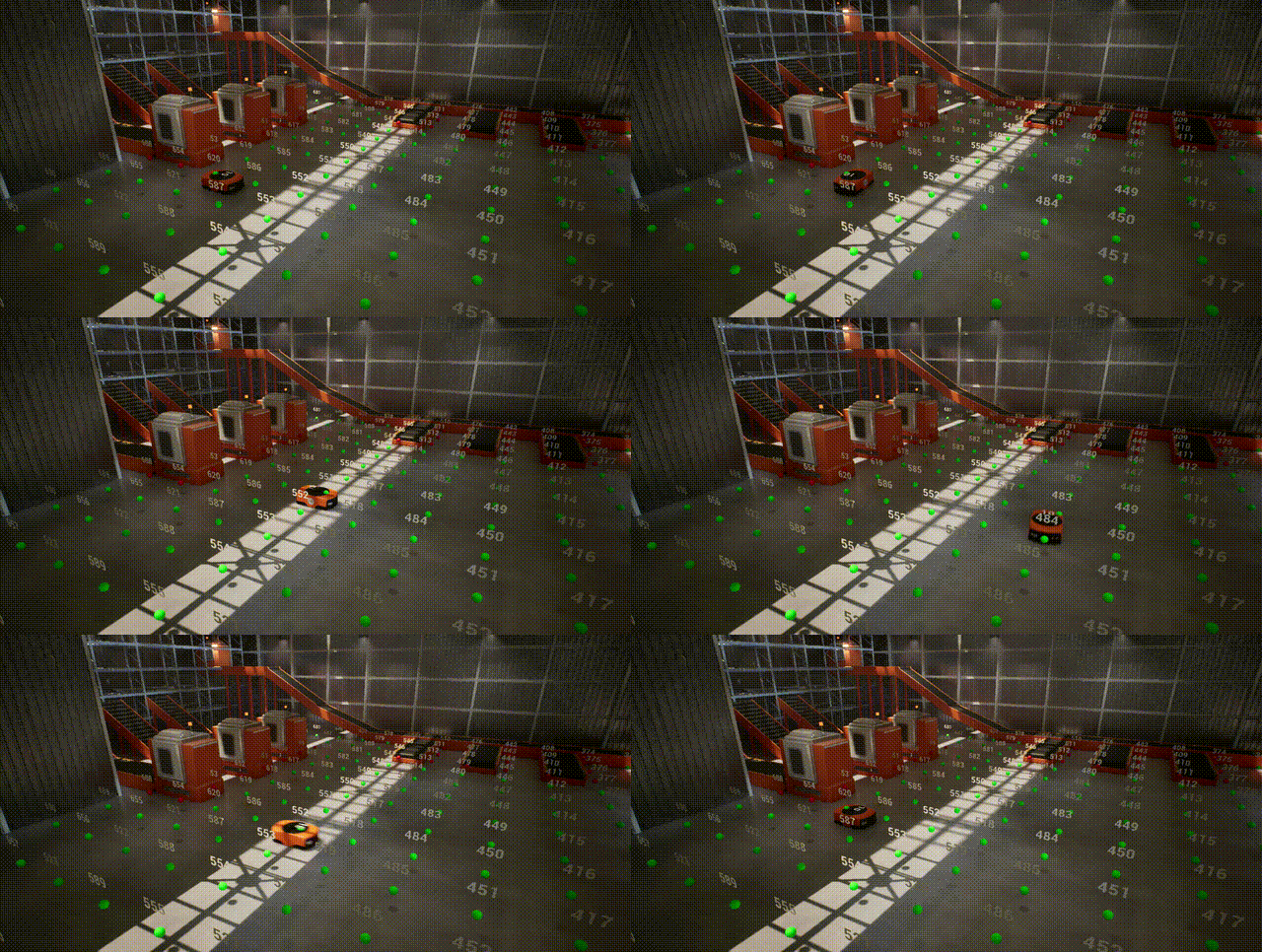
Helper scripts live in ~/ros_industrial_ws/ros_industrial_demo/test_scripts/vda5050 (one-time: pip install paho-mqtt).
cd ~/ros_industrial_ws/ros_industrial_demo/test_scripts/vda5050

# creates a command_updates to the vda5050 master (MQTT)
./send_command.py 10 P619 P585 P551 P517 P483 P484 P518 P552 P586 P620

# drive the sim directly, vda5050 client (MQTT)
./send_order.py 10 P619 P585 P551 P517 P483 P484 P518 P552 P586 P620
Why these P-nodes?
send_command.pyneeds an edge between each consecutive pair — the map is a 34-wide grid, soP<n>only links toP<n±1>(row) andP<n±34>(column). The route above is one connected chain. An arbitrary jump (e.g.P123 P501 P619) has no edge, so the master drops the rest and the robot stops at the first node.send_order.pysends directly to the simulation, bypassing the master, so any list of P-nodes works.
Watch what's happening on the wire:
mosquitto_sub -h localhost -p 1883 -t 'uagv/#' -v # all VDA5050 trafficThe master only emits an order from
send_command.pyonce the AGV is discovered (online and publishing state) and every node exists in its loaded map. If nothing moves, fall back tosend_order.py, which talks to the AGV directly.
Future development
This bridge is the seam where heterogeneous AGVs become controllable through one interface, and it's where most upcoming work lands:
- Robust order stitching — hardening sequence-id / orderId / updateId handling so long order streams never corrupt.
- Fuller VDA5050 coverage — more actions, instantActions, and richer state.
- Cleaner data-model mapping — a consistent AMR model so dashboards and MAPF read one shape regardless of robot vendor.
🧭 Future implementation target. The direction for this bridge is the ros-industrial/vda5050_core project — a VDA5050 implementation we intend to build on going forward.
Troubleshooting
docker logs vda5050_fiware --tail 50 # expect periodic "state" linesIf robots never move, confirm the bridge and the AGV/sim can both reach mosquitto:1883 on the shared network, and that the sim is online.